
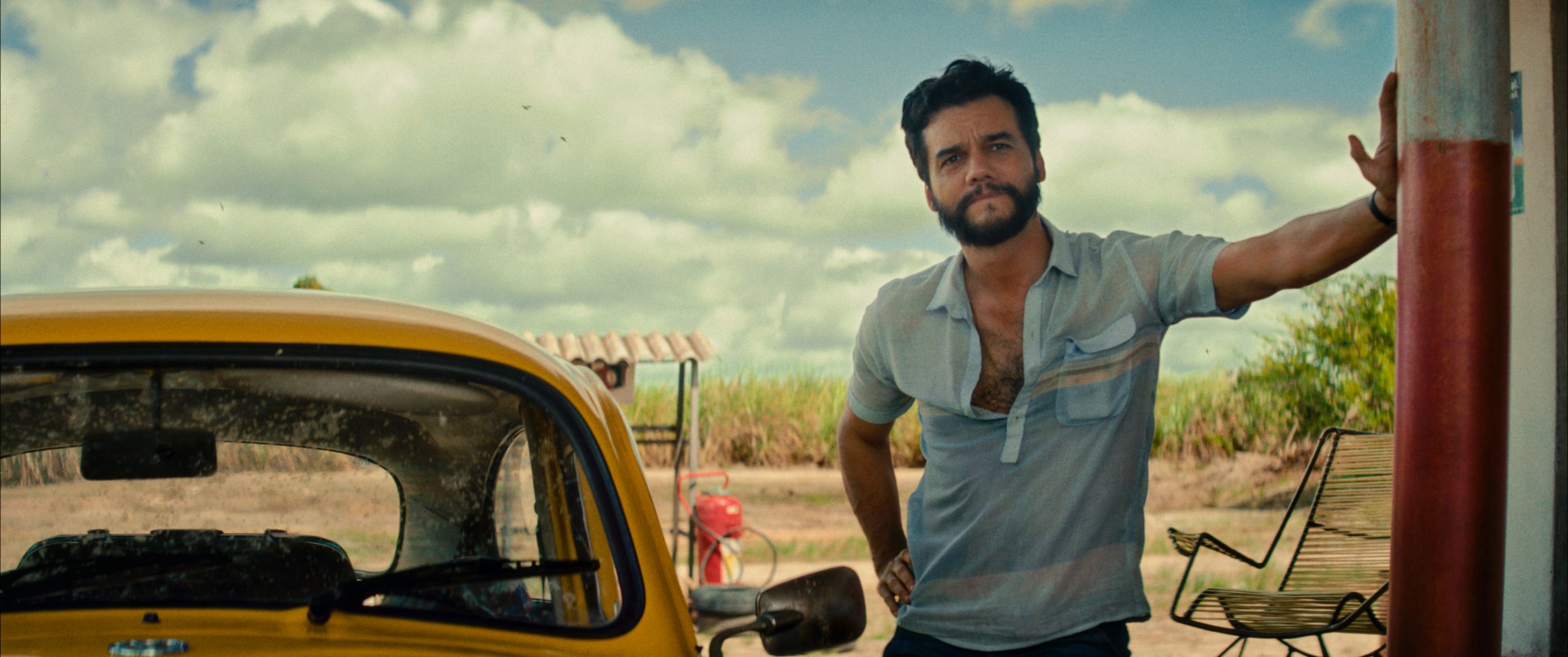
As the scientist Armando Solimões (Wagner Moura) stops his 1972 yellow Volkswagen Beetle at a sand-and-dirt-covered gas station in the rural countryside of Pernambuco, he notices a body covered in cardboard, the blood already as old as the land it has dried upon. A very informal fat brown man, tucked in small shorts and an open shirt, oversees the place. Police finally arrive at the scene, and they are more interested in harassing Solimões and asking for a bribe than checking the murdered body. They feel, at the same time, comical and menacing, and this scene sets the tone for Brazil’s ‘The Secret Agent,’ a tense thriller that infuses darkness with intelligent moments of tragicomedy. Like a mischievous but violent trickster.
This introductory scene serves as a résumé of what Brazil was like under the military dictatorship and what it is like to try to make it here today. Oppressive, improvised, comical, dramatic, paranoid, and charismatic all at the same time, these qualities are blended under the peculiar writing and lens of auteur Kleber Mendonça Filho, as well as the world-class acting skill of Wagner Moura.
‘The Secret Agent’ dialogues with Mendonça Filho’s memoir-documentary ‘Pictures of Ghosts’ (2023): both use Downtown Recife’s classic film palaces. In the documentary, these theatres are fading memories of a bygone, elegant era; in the Solimões saga, they become a character alongside the picture, with a blend of colonial, neoclassical, and art nouveau architecture. The same sun that gives the distinctive coloring and shades also touches the skin of locals, granting Recife a unique look compared to more well-known Brazilian cities like São Paulo, Rio de Janeiro, or Salvador. Mendonça Filho presents aspects of local culture that resonate abroad without losing identity—his film is a love letter to his childhood in Recife and its cinema culture.
Although Brazil has brought to the world many films depicting the dictatorship years, ‘The Secret Agent’ stands out. For the untrained eye, it feels like a B-movie, but this presentation is just a layer of a nuanced arthouse picture that can also entertain. The exploitation gene is more alive when the legend of the hairy leg is told during a friend’s meeting, and the narration is followed by scenes of an amputated hairy leg causing mischief in Recife’s night, which was, in fact, a way to expose the abuses of the dictatorial law enforcement agents during that era of suffocating freedom of expression. Not to forget that, according to the National Truth Commission, 434 people were killed or disappeared by the dictatorship. Nevertheless, experts like Eugênia Augusta Gonzaga believe this number exceeds 10,000 people.
Besides being another chapter of Brazil’s revisionism of its authoritarian past, ‘The Secret Agent’ follows the world success of Walter Salles’ ‘I’m Still Here’ (2024), in which a widow and mother of four defies the regime in search of her state-abducted, tortured, and murdered husband. Both films take place in the 1970s under the same government, but they feel very distinctive and showcase that Brazilian narrators have more stories from that period to tell, and ‘The Secret Agent’ keeps the Brazilian momentum in world cinema.
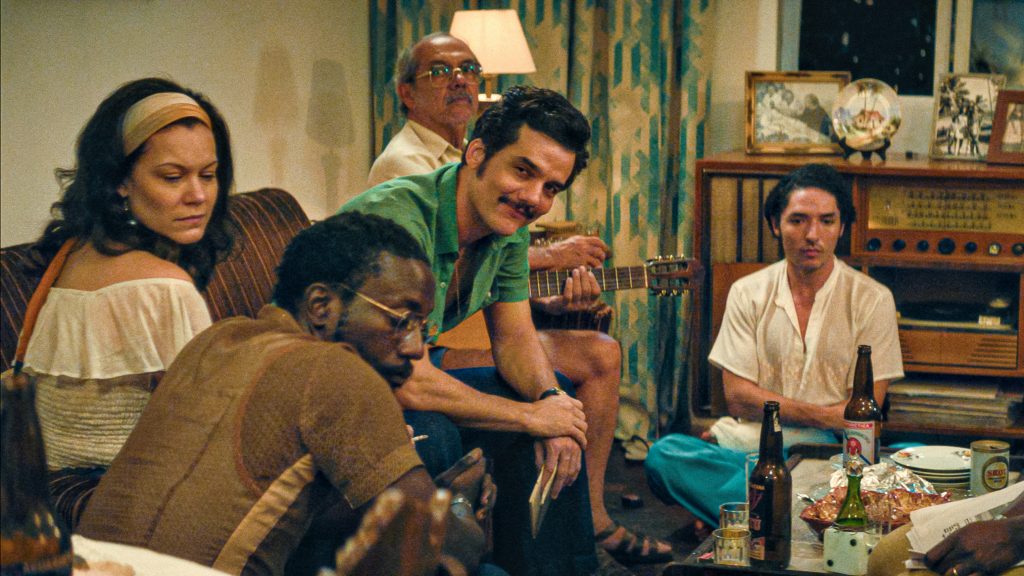
Since the last decade, Brazilian films have been gaining space abroad. To explore this trend, renowned Brazilian critic Sérgio Rizzo shared his perspective in an exclusive interview with The Big Picture Film Club. Rizzo explains the international award-winning picture in the global landscape: “For Brazilian cinema, the film’s successful international run represents yet another contribution to the self-esteem of audiovisual production in the country. Its international production and distribution alliances also help, following ‘I’m Still Here,’ to reinforce the image of Brazilian audiovisual production as a good partner, capable of creating works deeply connected to national culture and, at the same time, with the capacity to communicate with audiences in other countries, especially in Europe and the USA.”
Still, it is not an easy way to reclaim the role it had in the 70s and 80s as happened with ‘The Kiss of the Spider-Woman’ (1985) or the acclaim it got at the dawn of this century with ‘City of God’ (2001) and there is work to be done after ‘I’m Still Here’ and ‘The Secret Agent,’ according to Rizzo: “However, for the success of these two films to cease being merely episodic and become a permanent occupation of a space in the international spotlight, measures are needed in the area of public policies that strengthen the Brazilian industry in the medium and long term, which is not currently happening.”
A pool of international exchange under tropical weather
Brazilian pictures have attracted international talents like Italian legend Marcello Mastroianni in ‘Gabriela’ (1983), ‘My Hindu Friend’ (2015) with Willem Dafoe, and Frenchman Vincent Cassel, who has strong ties with the nation, was cast in ‘Adrift’ (2009) and ‘The Movie of My Life’ (2017). Late German veteran character actor Udo Kier was a collaborator of Mendonça Filho, playing the main antagonist in ‘Bacurau’ (2019), which also had a squad of foreign talents, and portraying a Holocaust survivor in ‘The Secret Agent,’ a metalanguage of authoritarian regimes and their everlasting impact on their survivors, and also his last role. These and other collaborations show that there is room for foreign talent in authorial and independent Brazilian films.
When asked what foreign talent can bring to the Brazilian table, Rizzo explains: “‘I’m Still Here’ and ‘The Secret Agent’ already feature foreign professionals, especially Europeans, in artistic and technical roles. These are concrete and successful examples of opening new avenues for internationalising work, which are fundamental to the audiovisual production system in the 21st century.”
‘The Secret Agent’ features impactful cinematography by Russia’s Evgenia Alexandrova, while ‘I’m Still Here’ has a rich soundtrack by Australian musician Warren Ellis. Rizzo further elaborates on these symbiotic international relations:
Just as the US audiovisual industry traditionally relies on the talent of professionals from other countries; the Brazilian audiovisual industry has its doors open to the participation of foreign ‘players’ in strategic positions. Actors and actresses, for example, can revitalize their careers by participating in auteur films with strong festival presence and high circulation on prestigious exhibition circuits, which, in turn, allows them to occupy spaces in the global media spotlight. Producers can associate themselves with local projects and benefit from this same privileged circulation.” – Sérgio Rizzo
In this current high-momentum period, Brazilian cinema can accommodate both veteran and emerging talents. Names like Academy Award-winning Melissa Leo, charismatic 80s leading man Philip Michael Thomas, and New Queer Cinema mainstay Guinevere Turner come to my mind as they can offer much on and off-screen. While actors that deserve greater leading status include Ireland’s Mark Ryder (Borgia) and local Alexandre Rodrigues, who brought ‘City of God’s Rocket to life. Although the future is uncertain, the Brazilian cinema community, alongside local and foreign talents and fans, should savour moments like the one unfolding in this unique, sun-bathed corner of the globe.
The Secret Agent is in cinemas now