

The documentary ‘Enigma’ delves into transgender identity and legacy through the stories of trailblazers, British trans activist April Ashley, who died in 2021, and the popular and mysterious French pop singer and lyricist Amanda Lear.
The movie is directed by Zackary Drucker, a trans storyteller and prominent documentarist, whose background enables her to see both women through the lens of someone who has endured similar issues and has felt similar happy moments in personal life and career, thus making ‘Enigma’ feel more grounded and natural.
Ashley talks about her childhood during World War II in Britain, growing up in a blue-collar family, having a Royal Navy sailor as her father, and sharing the household with 9 siblings. Ashley’s narrative shows how difficult it was to navigate her blossoming identity during those days. The Black-and-White photos, alongside the editing and narration, reinforce how grim such a childhood could be. Ashley’s upbringing feels like a queer Charles Dickens tale.
The film transitions to the Le Carrousel de Paris cabaret in 1950s France, a club featuring crossdressers and later transwomen performing in shows. For years, Le Carrousel was one of the most disputed spaces in Parisian nightlife, visited by the likes of Josephine Baker, Edith Piaf, Salvador Dalí, and Elvis Presley. It was there that Ashley found solace and a “home” after being discharged from the British Merchant Navy. It was also the place and time when she became acquainted with Peki d’Oslo, a male-born art student who started performing at the club, and Ashley took them under her wing.
The ‘Enigma’ circles the claim that Peki d’Oslo was Amanda Lear’s previous identity, a claim Lear denies. However, Ashley exposed it in her memoir and in the interviews featured in this documentary. The vivacious Lear is evasive when talking about her past before modelling in the UK and enjoying a successful musical career that started in 70s France, during the high days of Disco Music.
On the other hand, post-Le Carrousel, Ashley had a renowned career as a Vogue model until being outed in 1961, an event that unravelled through a public and embattled divorce with her husband in 1970, infused with societal shaming and the judge declaring her sex as “male,” thus setting the standard to defining trans people’s sex in the UK after their birth sex. Ashley would take part in many public interviews to clarify about her case and identity, and became one of the country’s trans rights beacons.
Ashley had a life of glass ceilings and roadblocks; still, she became part of London’s gastronomy circuit with a successful restaurant, and the legal precedent started with her divorce case was overturned decades later by the UK’s Gender Recognition Act of 2004, allowing trans people to change their sex on their birth certificate. On the cusp of her 70th birthday, Ashley was able to change her legal gender.
Zackary Drucker conducts interviews with Ashley and Lear. Meanwhile, Canadian London-based trans historian and activist Morgan M. Page interviews two of Ashley’s colleagues from the Le Carrousel de Paris, Bambi (Marie-Pierre Pruvot) and Dolly Van Doll (Carla Follis), as well as burlesque artist and advocate Allanah Star, a protégé of Bambi. The veterans also tell their own stories of struggle and victories; they also attest that Lear was part of the roster of performers. Still, Lear rebukes such claims with conviction, but remains elusive about her background and connections. Throughout her career, she gave different answers when talking about her past, which makes her a compelling character.
The identities behind the names and trans walks of life
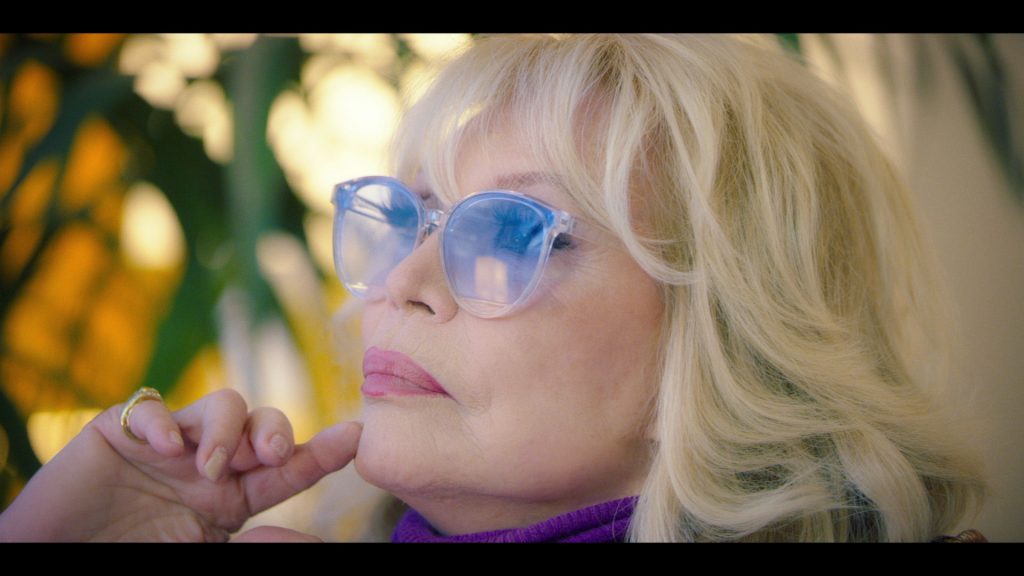
The alleged trans identity of Lear is considered an open secret within the LGBTQIA+ community and Parisian society, which is not a progressive safe haven for trans people. Still, it is less conservative than other European nations and the US. It is hard to imagine a trans singer achieving the success Lear had if they came out to the public.
Lear enjoyed a bustling life, having connected with the likes of surrealist painter Salvador Dalí and musicians David Bowie and Rolling Stones guitarist Brian Jones, not to mention that Lear was a successful Paco Rabanne model. Those from Le Carrousel attest that Peki d’Oslo was her stage name, while Amanda Tap was how she identified in daily life. Through a marriage with a British architect in the 60s, she became Lear.
To this day, Lear denies knowing Ashley, let alone being close friends. Drucker sees in Lear’s stance a survival strategy employed by many from the trans community. Nevertheless, Lear’s songs may allude to her real identity. Her 1980 song “Fabulous (Lover, Love Me)” has the subjective lyrics: “Surgeon built me so well nobody could tell that I once was somebody else.”
It is interesting to see in ‘Enigma’ the relation between birth, current, and artistic names that all those involved in this documentary have, and how this translates into how rich and complex each of their personalities is.
Nonetheless, the documentary shows how journalists can be vultures in their attempt to sensationalise trans lives while not regarding the societal and psychological trauma they are inflicting on interviewees and other trans people. After their “work” is done, they will move out to the next story, while others have to swallow the harrowing aftermath. But when Ashley approaches such identity, it feels more like showing other members of the community and outsiders how bright they can shine.
Drucker brings a respectful yet down-to-earth eye to Ashley and Lear. While Ashley is the archetype of a serious activist for trans rights, Lear is the charismatic star with an interesting juggle between identity and public presentation. Page’s interviewees add by further showing how difficult it is to thrive in society, in a time when trans women would change towns or even countries and present themselves as a cisgender born woman to live a peaceful life, thus neglecting their identity, as is told by Pruvot.
It is through Drucker’s eyes that these parallel life stories are told, and Drucker brings gravitas to the film while not falling into the condescending traps that ooze through the cracks or into out-and-loud advocacy. We see these situations when such characters are approached by those who aren’t from the community and lack common sense.
Though I believe some outsiders can bring a humane, crafted look to a specific community, and they should be encouraged to do so, a significant example is the late Brazilian documentarist, Eduardo Coutinho. Still, Drucker’s sensitive approach is part of what makes this story unique. Drucker has directed before the competent ‘The Lady and the Dale’ about trans-American automobile executive Geraldine Elizabeth Carmichael and her dark entrepreneurial story. Drucker can show light-hearted moments and others that are heavy; therefore, she never paints the queer community as one-dimensional characters nor makes propaganda. Drucker is a committed professional, and ‘Enigma’ is a fascinating portrait of transgender life and the times of Ashley, Lear, and others like them.